
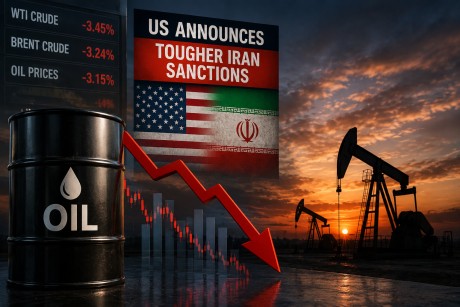
Oil prices experienced a significant drop of over 3% on Tuesday, reaching their lowest point in a week as investors considered the ramifications of new U.S. sanctions on Iran. This decline follows a period of gains, with Brent crude, the global oil benchmark, decreasing by 3.1% to $89.31 per barrel, and West Texas Intermediate (WTI) falling 3.34% to $82.17. Last week, both benchmarks saw substantial increases, with Brent rising by 6.6% and WTI by 5.7%.
The United States has intensified its sanctions on entities and nations engaged in economic dealings with Iran. These actions aim to exert further pressure on Tehran amidst ongoing geopolitical tensions and to disrupt its economic stability. The oil market’s response highlights its sensitivity to developments in the region, particularly concerning the Strait of Hormuz, a crucial global energy conduit.
Iranian officials have cautioned that oil shipments through the Strait of Hormuz could be obstructed if Washington continues to escalate its pressure. The strategic waterway is vital for global energy supplies, making any potential disruptions a significant concern for the international oil market.
Additionally, risks to shipping have escalated, with reports of a tanker being hit near Oman’s Musandam peninsula. Ongoing attacks in the Red Sea have further contributed to the uncertainty surrounding global energy supplies, complicating the situation for traders and investors.
Despite these geopolitical risks, the focus of traders shifted to the implications of the new sanctions, evaluating whether they would have a substantial impact on Iranian oil exports. This shift in focus contributed to the drop in oil prices, as market participants weighed the potential outcomes of the U.S. measures on the global oil landscape.